


None of this guarantees that the place becomes easier to understand or better to experience. Technology creates capability. The design question is what that capability should do for people.
This distinction will become more important as intelligence moves deeper into built environments. Buildings, districts and cities are increasingly able to sense conditions, process information and adapt how they operate or communicate. The boundary between physical and digital experience is becoming less distinct. For clients, the opportunity is significant. So is the risk of building layers of technology around an experience that was never clearly defined.
Innovation & Future Systems starts with the human purpose. It asks where emerging technology can genuinely improve how people understand, navigate and interact with a place, then considers the information, infrastructure, governance and physical integration required to make that experience work. The future built environment should not simply contain more intelligence.
It should use intelligence more intelligently.

The built environment is becoming an information system
Buildings have always communicated.
Entrances indicate access. Routes suggest movement. Materials distinguish spaces. Signs provide explicit information. Staff answer questions. Lighting, sound and activity influence what people notice and how they behave. Digital systems add another layer. A transport environment can communicate live departure information. A hospital can manage appointments and arrival instructions digitally. A destination can change information according to events or operational conditions. Sensors can identify occupancy or environmental change. Digital twins can connect physical assets with data. AI can help interpret complex information and support decisions.
At urban scale, the International Telecommunication Union's current work on smart sustainable cities encompasses IoT, digital twins, artificial intelligence, advanced analytics, sensing, automation and digital services alongside questions of interoperability, security, accessibility and sustainability.
The important shift is not simply that more devices are appearing in places. It is that physical environments are becoming capable of receiving, processing and responding to information. That changes what experience design needs to consider.
The building is no longer only a fixed physical environment with digital services attached to it. Increasingly, the physical place and its information systems can behave as one connected environment.
Start with the human problem, not the technology
Emerging technology attracts attention because of what it can do. That can encourage projects to begin with the solution. Where can we use AI? Should we create an augmented reality experience? Do we need a digital twin? Can information become adaptive? Should every visitor have a personalised journey? These are technology questions.
Experience design begins somewhere else. What problem are people experiencing? What decision needs to become easier? What information changes frequently enough to justify a responsive system? Where does personalisation add value? What does an operator need to understand in real time? Which physical constraints cannot be resolved through architecture alone? Only then should the project ask which technology is appropriate. This protects innovation from becoming a collection of features.
A sophisticated intervention that solves no meaningful human or operational problem creates complexity without equivalent value. It introduces infrastructure, interfaces, data requirements, maintenance and governance that the asset may carry long after the novelty has disappeared. The useful measure of innovation is not how new the technology appears.
It is whether the resulting experience performs better because the technology is there.
AI can change how places communicate
Traditional environmental information is largely predetermined.
A directional sign communicates a fixed destination. A directory contains an agreed hierarchy. A map represents a known environment. Digital screens may update content, but the underlying interaction remains relatively structured. AI creates the possibility of more dynamic relationships between people, information and place. A person could ask for a destination conversationally rather than interpreting a directory. Information could respond to language, accessibility requirements, operational disruption or journey context. Systems could help operators identify recurring areas of uncertainty from patterns in enquiries or movement data.
This could make complex environments more responsive. It also introduces new questions.
Where does the information come from? Who controls the source data? How is accuracy checked? What happens when a system generates a plausible but incorrect instruction? How does the user know whether information is current? What happens when connectivity fails? Which journeys should never depend entirely on an AI interface?
These questions are particularly important when information affects access, safety or essential services. NIST's AI Risk Management Framework is designed around managing risks to individuals, organisations and society throughout the development and use of AI systems. Its Generative AI Profile extends that thinking to risks specific to generative systems. For the built environment, the implication is clear: AI-enabled experience cannot be treated only as an interface design exercise. Trust, governance and failure conditions are part of the experience.

Future wayfinding will be adaptive, but physical legibility still matters
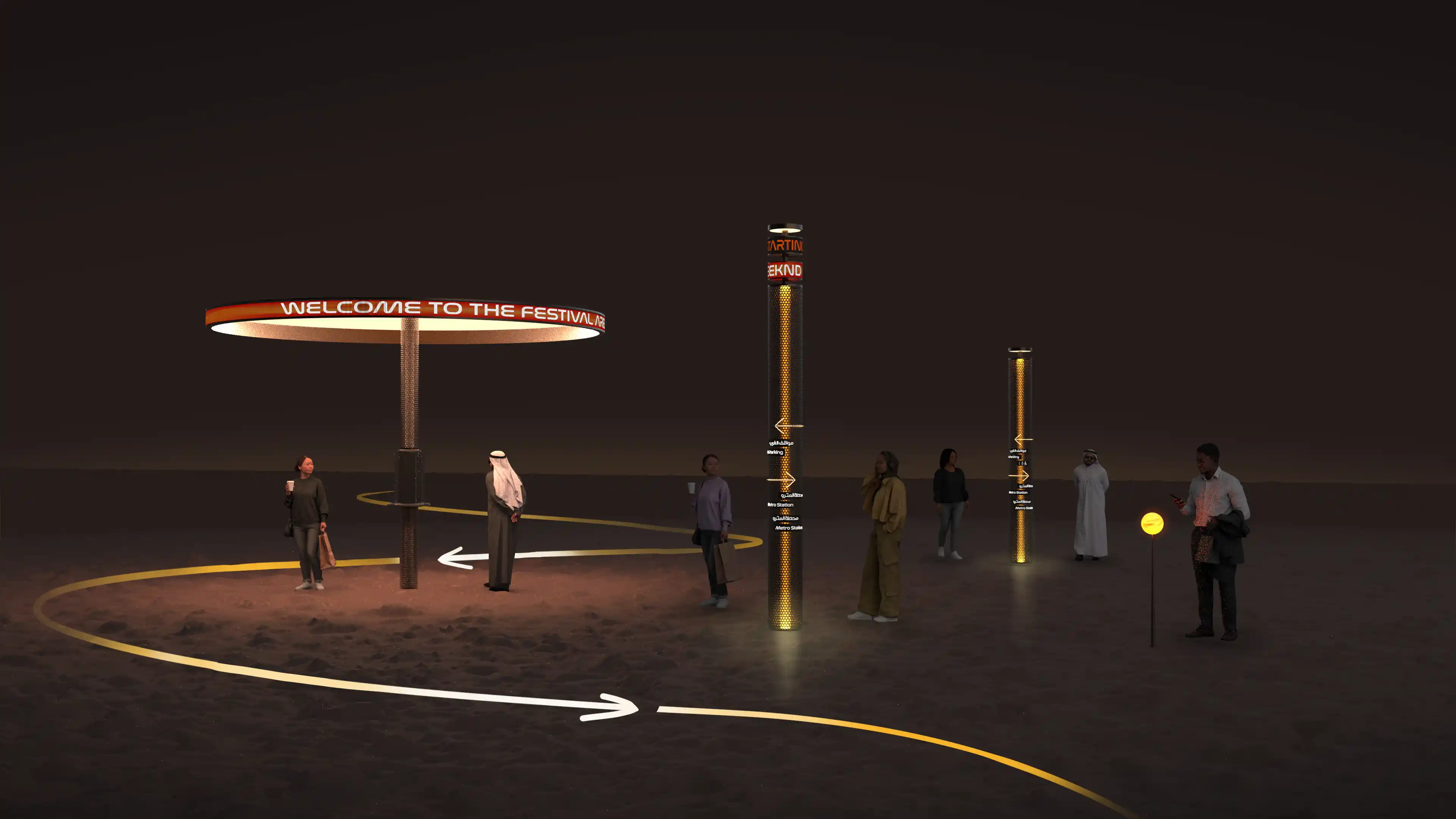
Navigation is an obvious area for greater intelligence. Conventional Wayfinding & Navigation establishes routes, destinations, decision points, naming and information hierarchies, using architecture, landmarks, digital tools, staff communication and physical signage as parts of a wider system. Future systems can make some of that information responsive.
A transport hub could adjust guidance when a route closes. An event destination could change information according to crowd movement or programme. A large mixed-use development could provide different levels of guidance according to destination, mode of travel or accessibility need. The information system no longer has to assume that every condition remains fixed.
But adaptability does not remove the need for a legible physical environment. A person should not need an application to recognise the principal entrance. A building should not become impossible to navigate because a screen is unavailable. An adaptive system cannot compensate reliably for inconsistent destination names across architecture, operations and digital platforms. The strongest future navigation systems will therefore be hybrid.
Physical space will establish fundamental orientation and route logic. Persistent information will communicate what needs to remain stable. Digital and adaptive layers will respond where conditions, users or operational requirements genuinely vary. Technology should add intelligence where intelligence is useful, rather than making basic comprehension technologically dependent.
Adaptive messaging changes the idea of a fixed information system
Many built environments operate differently throughout the day. Entrances open and close. Events alter circulation. Queues form. Transport services change. Areas become restricted. Tenancies and destinations change. Emergency or maintenance conditions temporarily alter routes. Fixed information has always struggled with this variability.
Responsive systems create the possibility of communicating according to current conditions. That might involve changing directional information, prioritising messages, communicating disruption or altering the sequence of information according to operational need. The design challenge becomes more complex because the project is no longer designing only the message. It is designing the rules governing when the message changes.
What triggers a change? Which data source is authoritative? Who can override the system? Which information must remain consistent regardless of condition? What happens when two operational priorities conflict? How is the user prevented from receiving contradictory instructions from different channels?
Adaptive communication therefore requires governance as much as interface design. Without clear rules and reliable information architecture, responsiveness can simply allow inconsistency to happen faster.
.gif)
Spatial computing can make digital information part of the place
Digital experience has traditionally been concentrated on screens. Spatial computing expands the possibility of relating digital content more directly to physical position and surroundings.
Information might be associated with a specific object, route, artwork or location. Digital guidance could respond to where a person is standing. Cultural interpretation could appear in relation to the physical environment rather than on a separate interface. Designers and operators could use spatial models to understand proposed changes before they are implemented. This creates new opportunities for built environment experience design because digital information can become context-specific. But the same principle applies: the technology needs a reason to exist.
Not every physical experience improves when a digital layer is placed over it. There are also practical questions around device access, accessibility, privacy, accuracy, maintenance and the degree to which an experience should depend on personal technology. The physical environment remains the common interface available to everyone who enters the place.
Spatial computing is most useful when it extends that environment rather than becoming a requirement for understanding it.
Digital twins can connect experience with operations
Digital twins are increasingly relevant to cities and complex assets.
The ITU describes a digital twin in the smart sustainable city context as a virtual representation serving as the real-time digital counterpart of a physical object or process. Its work identifies applications in planning, operation and other urban systems. For experience design, the opportunity is not the digital model itself. It is the relationship between operational information and what people experience. Imagine a system that understands that a lift is unavailable, a route is congested or an entrance has temporarily closed. If that information remains within a facilities platform, the operator may know about the condition while the person navigating the environment does not. A more connected system could allow operational change to influence relevant public information.
This begins to link asset intelligence with experience intelligence. The same relationship can work in the other direction. Patterns of movement, repeated assistance requests or interaction with information systems may reveal conditions that deserve operational or design attention, subject to appropriate data governance and privacy controls. The potential is a more continuous relationship between how a place operates and how it communicates.
That is more useful than treating the digital twin as an impressive visual representation disconnected from the human journey.
Responsive environments move beyond information
Future systems are not limited to navigation and communication. Environments themselves can respond.
Lighting can change according to occupancy or conditions. Environmental controls can adjust. Interfaces can alter according to context. Spaces can support different operational modes. Sensors can allow the asset to understand aspects of how it is being used. This creates a shift from designing fixed conditions to designing behaviours.
For the design team, that means defining not only what an environment should be, but how it should respond under different circumstances. The questions become partly experiential and partly operational. What should change? Why? For whom? At what point? What should remain stable so that the place continues to feel understandable? How visible should the system's response be? When does adaptation improve comfort or clarity, and when does unpredictability make the environment harder to trust?
A responsive environment should not feel arbitrary. People need enough consistency to build expectations about how a place works. The sophistication lies in adapting what benefits from change while protecting what people rely on for understanding.
Smart cities need a human experience layer
At city scale, the potential of connected systems becomes much larger. Transport, public space, municipal services, mobility, energy, information and infrastructure can all generate and respond to data.
ITU frames smart sustainable city development around digital technologies including IoT, AI and digital twins while emphasising people-centred urban transformation. UN-Habitat's work on responsible AI in cities similarly identifies governance and the experiences of people living in cities as central considerations. This matters because a technically connected city is not automatically an understandable city.
People still need to know how to access services, change transport modes, navigate districts, interpret information and understand what a system is asking them to do. As urban systems become more intelligent, the number of possible interactions increases. So does the need for coherence.
A resident should not have to understand the organisational structure behind every service. Physical and digital information should not use competing location systems. New technology should not create barriers for people who cannot or choose not to use a particular device. The smart city therefore needs more than technology architecture.
It needs experience architecture.
Personalisation needs limits
Adaptive systems create the possibility of increasingly personalised environments. Information could respond to language, mobility needs, destination, preferences or previous behaviour. Digital interfaces could reduce irrelevant information and prioritise what matters to an individual journey. There is genuine value in this. There is also a boundary between useful personalisation and unnecessary surveillance.
A system does not need to know everything about a person simply because the technology makes collection possible. Projects need to establish what information is necessary, what benefit it creates, how consent and privacy are handled and what experience remains available to someone who does not participate. This is particularly important in public and semi-public environments, where people may have little practical choice about entering the space.
Future systems should therefore be designed around proportionality. Use the minimum intelligence necessary to create the intended benefit. Make the purpose understandable. Protect basic access and usability when personalisation is unavailable. Trust is not separate from user experience. It is part of it.
Interoperability may matter more than individual features
A recurring challenge in smart environments is fragmentation. The building management system knows one thing. The visitor application knows another. Physical signs use one destination name. Booking systems use another. Mapping platforms identify a different entrance. Operational teams update information through separate channels.
Adding intelligence to each individual system does not necessarily solve this. It may make the fragmentation more sophisticated. Future built environments need stronger relationships between systems. That includes common naming, reliable data sources, clear ownership, defined interfaces and rules governing which system is authoritative for different types of information. Interoperability is already a significant part of international smart-city standards work. For experience design, its importance is straightforward: people should not have to absorb the consequences of systems that cannot agree with each other.
A connected experience depends on connected information.
Innovation has to survive opening day
New technology is often easiest to imagine during design and hardest to sustain during operation. Someone has to own the data. Software needs updating. Hardware reaches the end of its life. Vendors change. Cybersecurity requirements evolve. Interfaces need maintenance. Content becomes outdated. Operational teams need the authority and capability to manage the system. The experience strategy therefore needs to look beyond launch.
What happens in year five? Can components be replaced without rebuilding the whole system? Can the asset change provider? Is information structured so that it can support future interfaces that do not yet exist? Which decisions create long-term dependency on proprietary platforms? These questions can be less exciting than discussing AI or spatial computing.
They are also what determine whether innovation becomes part of the asset or a short-lived installation. Future readiness is not the ability to predict every technology that will emerge.
It is the ability to create systems that can adapt without losing their human purpose.
Innovation & Future Systems needs to begin before technology procurement
If innovation is introduced only when individual technology packages are being procured, many of the most important decisions have already been made. The project may already have fragmented data. Physical interfaces may be fixed. Technology infrastructure may have been designed around separate disciplines. Experience requirements may never have been translated into system requirements.
Innovation & Future Systems should begin earlier. It can identify where changing technology is relevant to the intended experience, where flexibility should be protected, which information systems need to connect and what principles should govern future adaptation. That work then needs to connect with architecture, operations, Wayfinding & Navigation, Physical-Digital Experience Systems, technical delivery and governance.
The purpose is not to predict the future perfectly. It is to prevent today's project decisions from unnecessarily restricting tomorrow's possibilities.
The next generation of places should become more human, not more technological
AI, spatial computing, digital twins, responsive environments and smart-city systems will continue to change what built environments can do. The technology will become more capable. That makes the design question more important, not less.
What should the place know? What should it respond to? Which decisions should remain understandable without technology? When should information adapt? What should never be automated? What does the operator need to control? What does the user need to trust? These questions sit between architecture and human behaviour.
That is where Innovation & Future Systems becomes a Built Environment Experience Design discipline rather than a technology exercise. The goal is not a place that constantly demonstrates how intelligent it is. The goal is a place that uses intelligence to become easier to understand, more responsive to genuine needs and better able to adapt as those needs change. The most successful future systems may eventually become almost invisible. People will simply experience a place that understands what it needs to do.