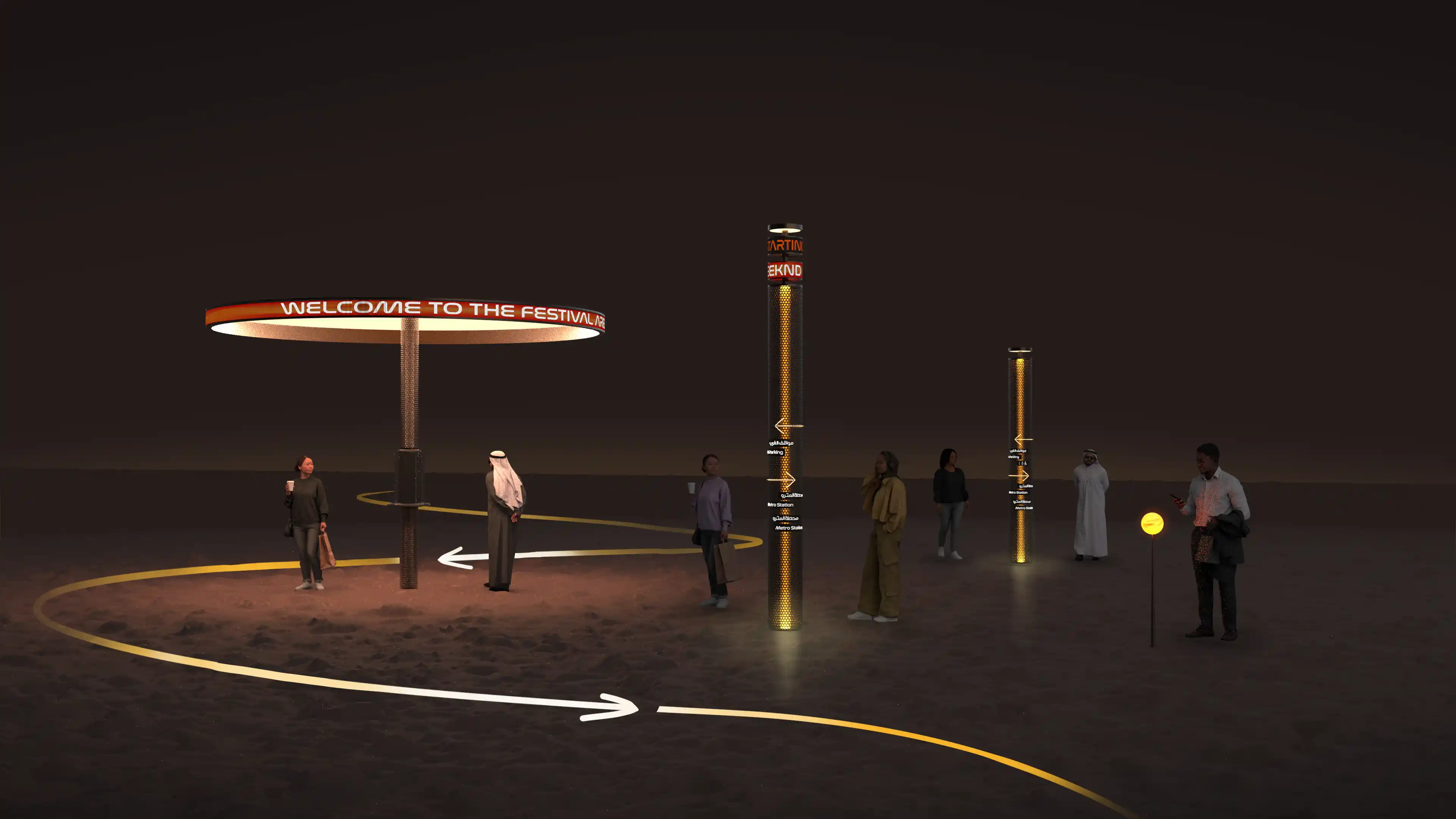



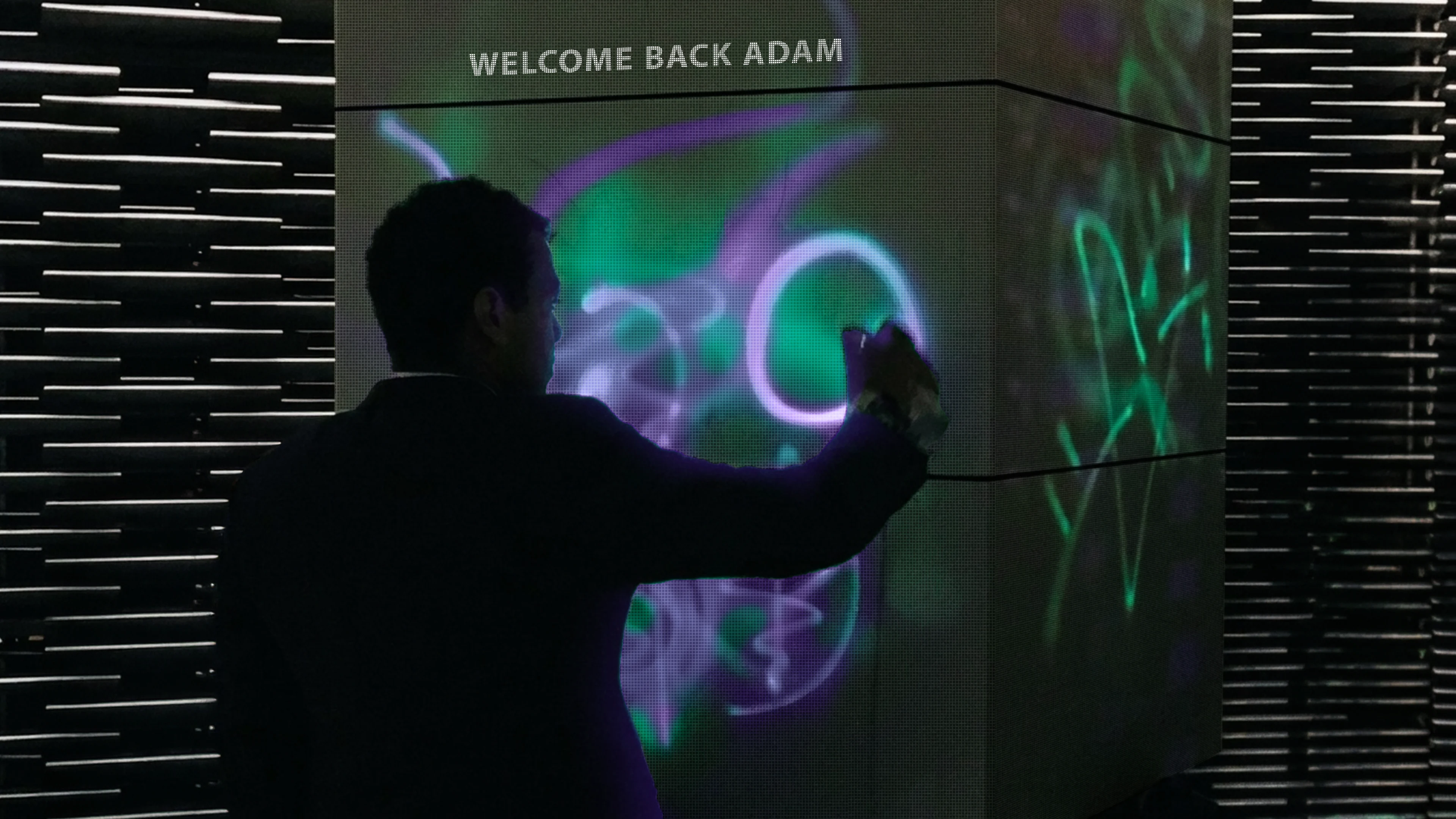
The technology may be sophisticated, yet the user still encounters separate channels. Information on the website differs from information on site. The app uses one set of destination names while the signs use another. A kiosk can locate a facility but cannot explain the physical route clearly. Operational data exists, but it does not improve what people experience.
The problem is not a lack of technology. It is the absence of a shared human logic connecting the physical environment, digital interfaces, information, operations and behaviour.
Physical-Digital Experience Systems create that connection. They define how people move between place, screen, device, service and information as one continuous journey. Technology becomes valuable when it removes friction from the environment and helps people understand what they can do, where they should go and what happens next.
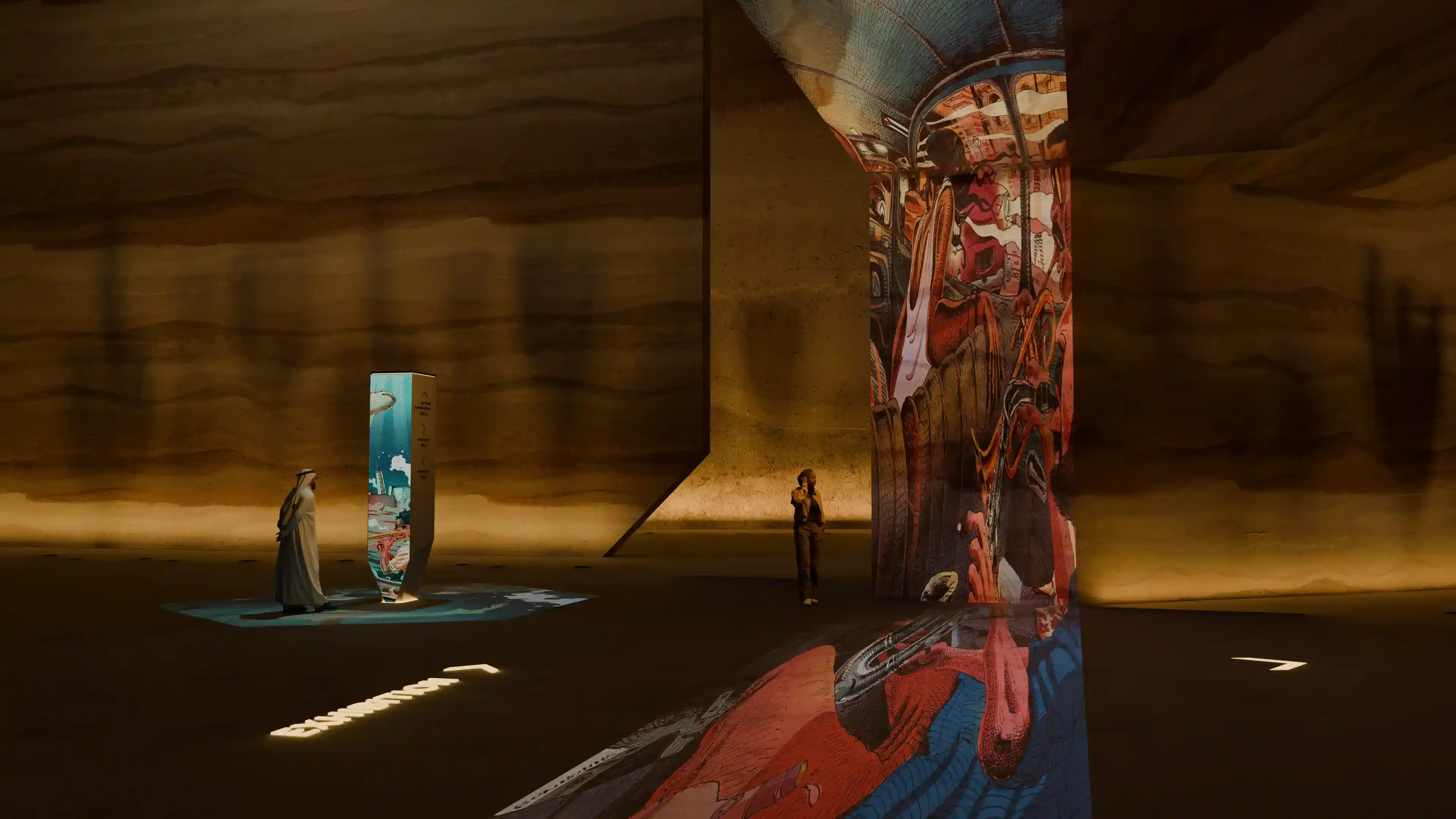
Connected technology does not guarantee a connected experience
Technology is often introduced through separate project packages. One team develops an app. Another supplies kiosks. A wayfinding consultant plans signs. The building management system collects data. An operator selects platforms after opening. Each appointment may have a valid scope, but no one is responsible for the relationship between them.
The user receives the consequences. They repeat information already provided online. They leave a digital route when the physical environment becomes unclear. They move between interfaces that use different language, maps and assumptions. When something changes, one system updates while another remains out of date.
This fragmentation also affects operators. Content must be maintained in several places. Data cannot be compared easily. Staff compensate for gaps between systems. Technical upgrades become difficult because the original connections were never defined.
A connected environment therefore needs more than interoperability between devices. It needs continuity of intent. Every touchpoint should support the same journey, information structure and operational reality.
The first design question should not be which technology the project can install. It should be which human and operational problems the complete system needs to solve.

One journey should govern every channel
People do not separate a place into architectural, digital and operational experiences. They prepare before arriving, approach the destination, enter, orientate, move, interact, receive services and leave. Their understanding develops across the complete sequence.
A useful physical-digital strategy maps that journey before defining interfaces. It identifies what people need to know at each stage, which decisions the environment must support and which channel is best suited to each task.
Some information belongs before arrival. Some is only useful when connected with a person’s live position. Some should remain visible in the environment rather than hidden inside a device. Some interactions need staff support, a physical control or a clear alternative when technology is unavailable.
The journey also reveals transitions between channels. A route selected on a phone should remain understandable when the user looks up. A booking confirmation should use the same destination language that appears at the entrance. A parking system should connect with arrival, pedestrian navigation and the final return journey rather than ending when the vehicle is parked.
Experience Strategy defines the human and operational intent. Physical-Digital Experience Systems turn that intent into a connected network of touchpoints that can work in the real environment.
Digital touchpoints must belong to their physical context
An interface used in a building is not the same as an interface used at home. The user may be moving, carrying luggage, managing children, dealing with noise, standing in bright light or trying to make a decision quickly. Their attention is divided between the screen and the environment around it.
This changes how digital touchpoints should be designed. A kiosk needs to consider approach, visibility, reach, dwell time, privacy, queueing and the route that follows the interaction. A public screen needs a clear viewing position and information that can be understood at the available distance. A mobile interface must recognise when the person needs a broad overview and when a simple next action is enough.
The physical setting also determines what happens when an interaction fails. Can the user recover? Is there another source of information? Can staff see the same information and assist? Does the environment still provide enough orientation when a device loses power, connectivity or location accuracy?
Digital systems should strengthen the place rather than demand that the place reorganise itself around a screen. The most successful touchpoint may be the one that appears only when needed and then allows attention to return to the physical journey.
User Touchpoint Systems and Interactive User Interfaces will examine these questions in greater detail. At the Primary Service level, the principle is that every interface must be designed as part of a spatial, behavioural and operational context.
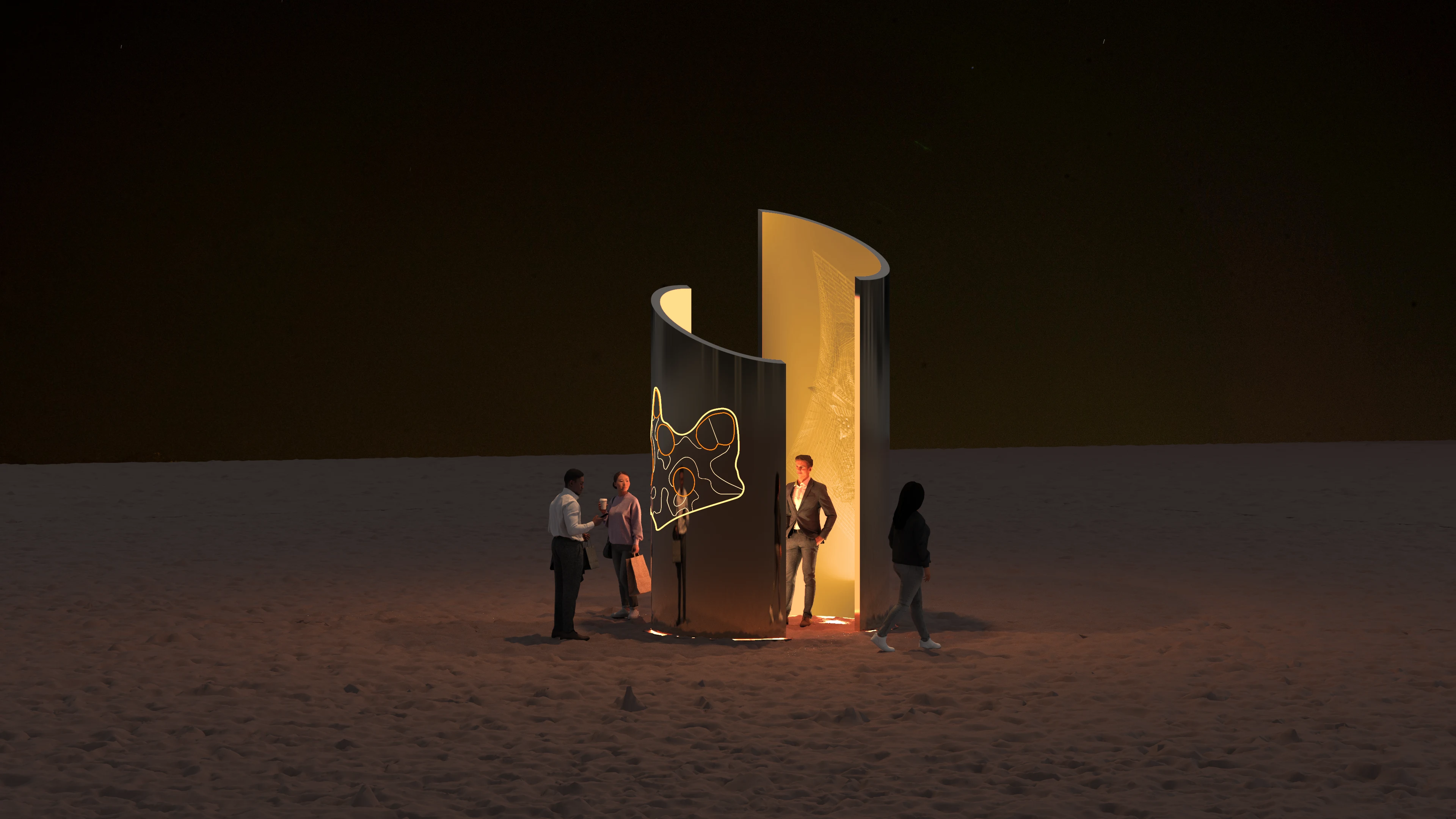
Interactive navigation depends on shared information
Interactive navigation is often treated as a digital version of a map. That approach misses the more difficult problem.
A navigation system needs a common information structure across physical and digital channels. Destination names, levels, zones, entrances, route types, accessibility information, landmarks and operational status must mean the same thing wherever they appear.
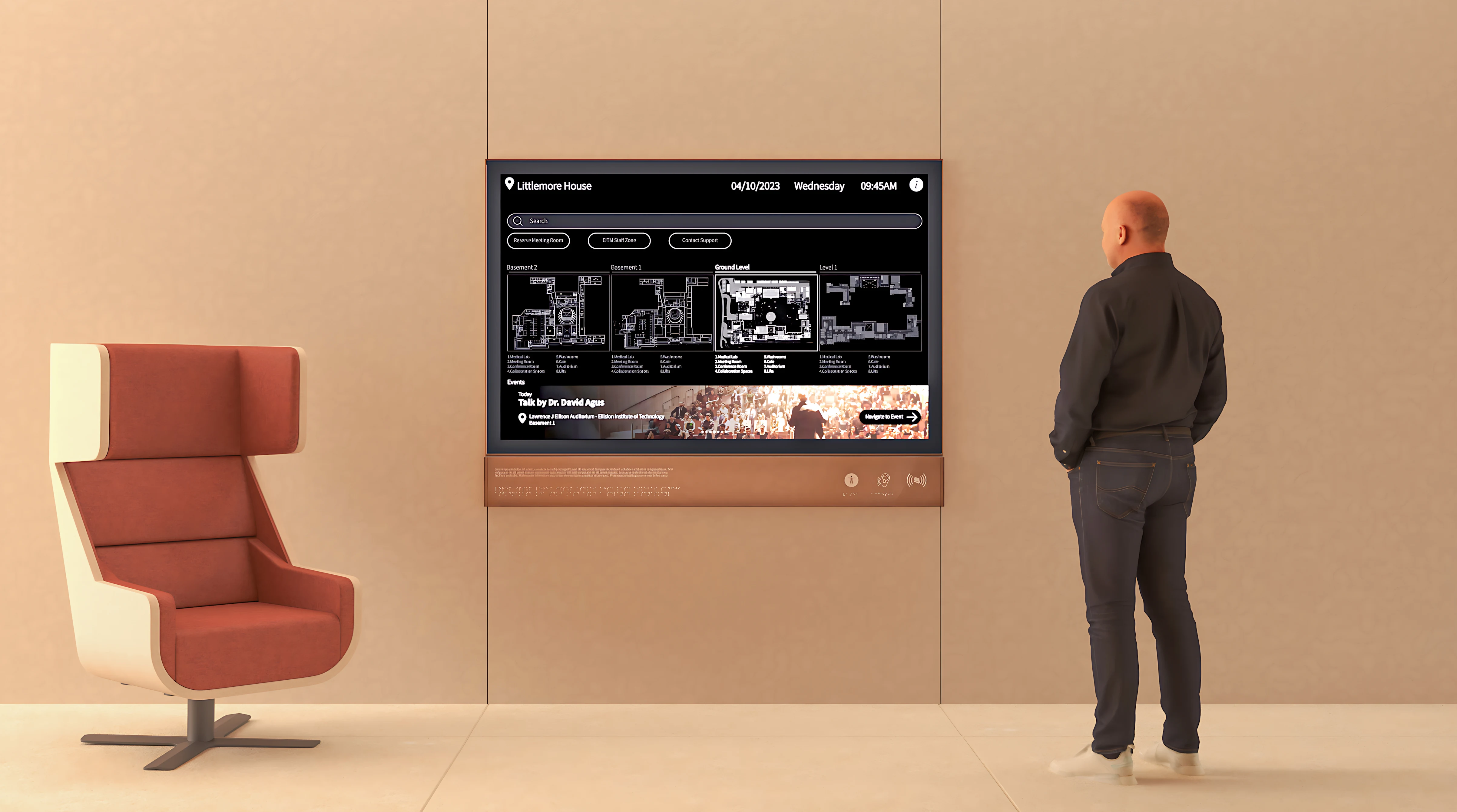
Without that foundation, the interface can calculate a route that the environment cannot communicate. It may direct someone towards an entrance known to the database but not recognisable on site. It may use precise indoor positioning while ignoring a confusing threshold. It may offer an accessible route without reflecting a temporary closure or the way assistance is actually provided.
The digital and physical maps also need a shared spatial model. The system should understand how people experience the route, not only how network nodes connect. Vertical movement, security checks, transfer times, sightlines, decision points, areas of hesitation and changes between indoor and outdoor conditions all influence whether guidance feels credible.
Wayfinding & Navigation owns the logic of orientation and movement. Physical-Digital Experience Systems extend that logic across screens, devices, live data and interactive guidance. The value lies in continuity between what the interface says and what the person can perceive in the place.
Smart systems need a behavioural purpose
A smart environment can sense conditions, process information and adjust what it does. That capability is useful only when the response supports a defined human or operational need.
Occupancy data might help direct people away from congestion. Environmental data might adjust information or atmosphere. A queueing system might change arrival instructions. A responsive display might prioritise content according to location, time or current conditions.
The risk is automated activity without experience judgement. A system may respond correctly to a data point while producing the wrong effect for the user. Constantly changing information can weaken trust. Personalisation can become intrusive. Adaptive messages can conflict with permanent signs. A technically responsive space can feel unpredictable if people do not understand why it is changing.
This is why smart environments need explicit decision rules. The project should define what the system is allowed to change, what must remain stable, which signals take priority and when a human operator should intervene.
Responsive behaviour should reduce effort, not display technical capability. The environment becomes smarter when it makes the next decision clearer and the operation more manageable.
Sensors create evidence, not understanding
Sensors can record occupancy, movement, environmental conditions, interaction and system status. They can reveal patterns that would otherwise remain invisible. They can also create a false sense of certainty.
Data shows what was detected. It does not automatically explain why people behaved in a particular way. A crowded route may indicate demand, confusion, attraction, closure or a temporary operational condition. Low use of an interface may mean it is unnecessary, poorly located, difficult to understand or simply unknown to users.
Interpretation therefore needs context. Sensor data should be considered alongside the spatial plan, user journey, operational events, staff observations, maintenance records and direct feedback. The objective is to understand the relationship between environment and behaviour rather than produce a dashboard of activity.
Collection also needs discipline. Projects should know what data is necessary, how it will be used, who can access it, how long it remains useful and what risks it creates. Connected devices interact with the physical world, which means cybersecurity and privacy decisions can affect real operations as well as information systems.
Experience Analytics will go deeper into measurement and continuous improvement. The parent service should establish the rule that every data source needs a decision it is intended to improve.
Analytics should lead to action
Many projects collect data because the technology makes collection possible. Far fewer establish how evidence will change the environment after opening.
Useful experience analytics begins with a performance question. Where are people hesitating? Which routes depend heavily on staff assistance? When does demand exceed the capacity of a space or service? Which information is repeatedly requested? Where do digital interactions stop before completion?
The answer should lead to a defined action. Content may need to change. A route may require stronger physical cues. An interface may need a simpler task sequence. Operational policies may need adjustment. A temporary pattern may need monitoring rather than a permanent design response.
This creates a feedback relationship between the physical and digital environment. The place generates evidence. The team interprets that evidence. Improvements are made across space, information, interfaces and operations. The effect is then reviewed again.
Analytics becomes valuable when it supports this cycle. A large volume of data is not a measure of insight. The measure is whether the project can make better decisions because the evidence exists.
Digital twins should support decisions beyond visualisation
A digital twin is most useful when it creates a maintained relationship between a physical asset and a digital representation of its condition, information, processes or behaviour. Its value is not the visual model alone.
For experience design, this relationship can connect spatial data, destinations, routes, assets, sensors, content and operational status. A change to an entrance, tenant, lift, service point or circulation route can then inform the systems that depend on it.
This can create a stronger foundation for navigation, asset management, scenario testing and future interfaces. It can also reduce the risk that separate digital products build their own incompatible versions of the same place.
The challenge is governance. The project needs to decide which information is authoritative, who maintains it, how systems exchange it and what happens when the physical environment changes. A model that is impressive at handover but cannot remain current has limited operational value.
Official digital-twin guidance has consistently emphasised purpose, trust, function and secure data connection. Those principles matter because a digital twin should serve real decisions and users rather than become another isolated project output.
Spatial Computing Readiness will explore how spatial data, coordinates, anchors and digital twins can support future augmented and immersive layers. The Primary Service should first ensure that the shared information foundation is useful today.
Human-AI interaction must earn trust
Artificial intelligence can help connected environments interpret requests, predict demand, adjust guidance, personalise information or assist operators. It can also introduce new uncertainty into situations where people need clear and dependable answers.
An AI system operating in a built environment is part of a wider social and technical context. Its response can influence where someone moves, which service they use, how long they wait and whether they feel safe or supported. Reliability, transparency, privacy, security and human oversight therefore affect the experience directly.
People should understand what the system can do, what information it uses and when they are interacting with automation. They need a way to recover from a poor response and reach a human or an authoritative alternative when the situation requires it.
The system should also recognise the limits of personalisation. A suggestion may be convenient, but it should not narrow choice, conceal other options or make assumptions that affect accessibility and fairness. The correct level of automation depends on the consequence of the decision and the conditions in which it is made.
Human-AI Interaction will develop this subject as a dedicated article. Within the parent service, the requirement is clear: AI should support human judgement and agency rather than make the environment harder to question or understand.
A connected environment needs a maintained system
Physical-digital experiences continue after the project opens. Content changes, tenants move, routes close and software is updated. Devices age, data structures evolve and new interfaces are added by different teams.
Without governance, the experience gradually separates. The app reflects one version of the place, kiosks another and physical information a third. Operators create workarounds because formal systems cannot respond quickly enough. Users lose trust when digital guidance and reality disagree.
The system therefore needs ownership. Clients should know who approves destination names, updates spatial data, manages content, monitors performance and coordinates changes across physical and digital channels. They should also understand which suppliers control critical components and how information can move if a platform is replaced.
Cybersecurity, privacy, accessibility, resilience and continuity should be considered across the lifecycle rather than assigned to a final compliance review. NIST guidance for connected devices and AI similarly treats risk as an ecosystem and lifecycle concern, not a feature that can be added to one component in isolation.
Governance is part of the experience because it protects accuracy, reliability and trust after the original design team has left.
A complete physical-digital system needs shared decisions
The exact architecture will vary, but a complete Physical-Digital Experience System should resolve the relationships between:
- The users, journeys, decisions and operational outcomes the system should support.
- The physical spaces, routes, thresholds and service moments where interaction occurs.
- The information architecture, terminology and spatial data shared across channels.
- The roles of signs, mobile devices, kiosks, public screens, staff and environmental cues.
- The smart systems, sensors, interfaces and data sources required for specific purposes.
- The rules governing responsive behaviour, personalisation, AI assistance and human intervention.
- The accessibility, privacy, cybersecurity, resilience and failure conditions that must be addressed.
- The analytics, ownership, maintenance and governance required to improve the experience over time.
These decisions should be connected before platforms and devices are selected. A kiosk depends on information and physical location. A navigation app depends on destination language, spatial data and live operations. A sensor depends on a decision the resulting evidence can inform. A digital twin depends on ownership and maintenance. An AI assistant depends on trusted information, clear boundaries and a recovery path.
Procurement can still divide the work into packages, but the experience architecture needs to remain whole. Clients should be able to see how every component contributes to the journey and what happens when one part changes or fails.
Physical-digital thinking needs to begin before procurement
Physical-Digital Experience Systems have the greatest influence when they can shape requirements before technology choices narrow the solution.
During strategy and concept planning, the work can define journeys, touchpoints, information needs, spatial data, operational responses and experience principles. It can help architecture and infrastructure teams protect locations, sightlines, power, connectivity and access without committing too early to a particular interface or supplier.
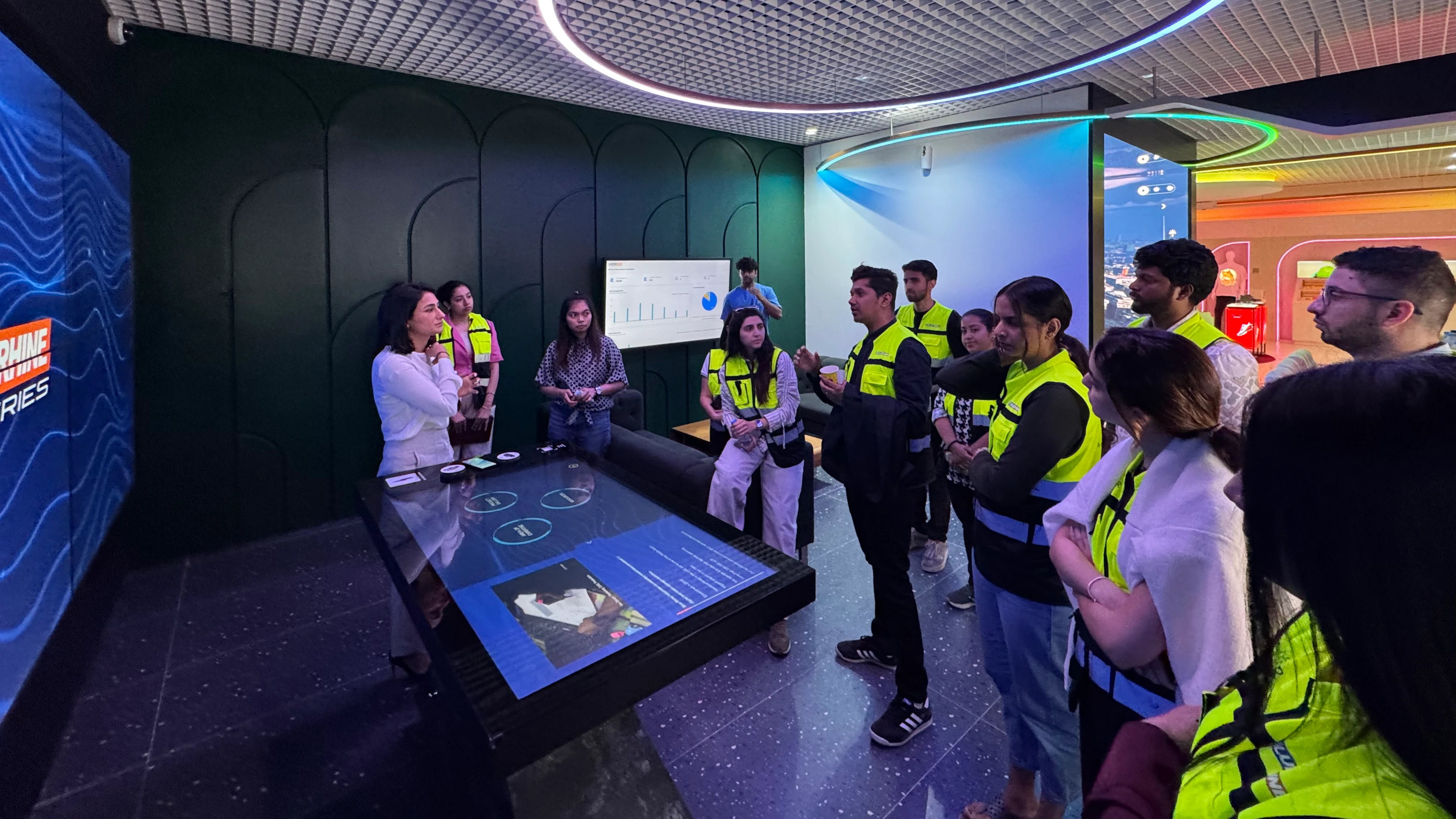
As design develops, the system can coordinate content, physical placement, interface behaviour, data structures and technical dependencies. During delivery, it can support prototypes, integration testing and validation across real journeys rather than checking each component separately.
After opening, the same framework can guide performance review, content updates, platform changes and future layers. This continuity matters because connected environments evolve. The project needs a system that can absorb change without losing the original human logic.
When the work starts late, technology often inherits unresolved problems. Interfaces compensate for weak spatial planning. Platforms create destination names independently. Sensors are installed without a measurement strategy. Digital twins are delivered without an operating model. The project spends more on connectivity while preserving fragmentation.
Early involvement does not require predicting every future technology. It requires defining the stable human, spatial, information and governance foundations that future systems will need.
Connect the purpose before connecting the technology
The future of the built environment will involve more data, more responsive systems and more interaction between people and intelligent technology. That does not make every connected environment better.
The quality of the experience will depend on whether those systems share a clear purpose. People should be able to move from physical space to digital guidance and back again without feeling the joins. Operators should be able to see, understand and improve the complete journey. Technology should respond to the environment without making it unpredictable.
Physical-Digital Experience Systems provide the structure for that continuity. They connect place, information, interfaces, data and operations around human behaviour.
The final test is not how many systems have been installed. It is whether the environment has become easier to understand, more useful in operation and more capable of adapting without losing trust.
When the purpose is connected first, the technology can take its proper role. It becomes part of how the place works rather than another layer people must learn to manage.