


Buildings Rarely Fail Loudly, They Fail Quietly Through Use
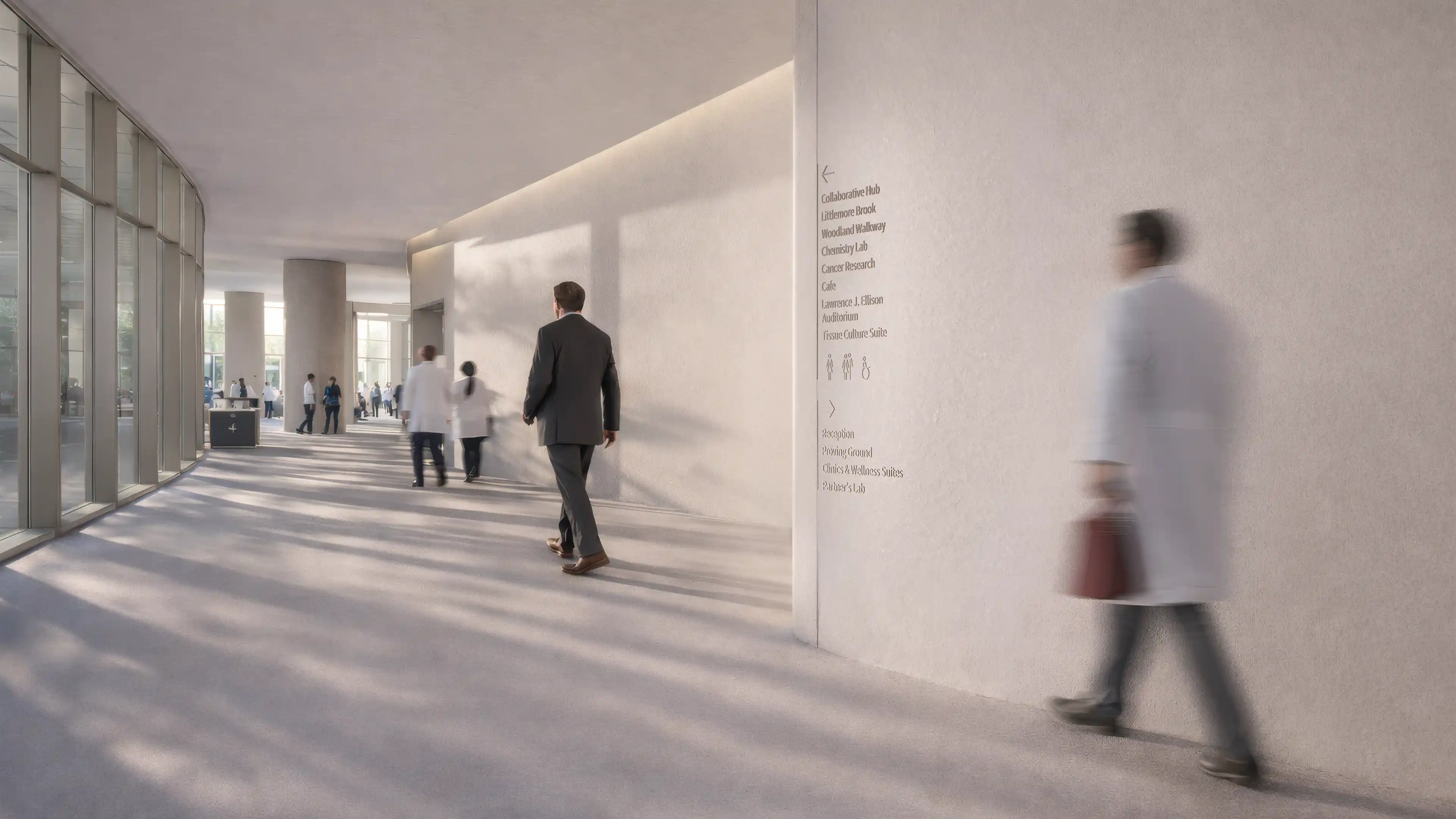
Most projects are judged at handover through photography, awards, or architectural intent. The real test happens later, when thousands of people move through the space without guidance. This is where problems emerge, not as dramatic failures, but as friction. People hesitate, double back, ask for help, miss destinations, or simply feel disoriented without understanding why. Across sectors, from hospitals to mixed-use developments, this pattern is consistent. The building works in theory, but not in practice. Circulation becomes inefficient, stress increases, and the experience degrades. These are not minor issues. They directly affect safety, operations, and commercial performance, yet they are rarely traced back to their source. That source is almost always a failure to design for how people navigate.
Wayfinding Is Not a Layer, It Is a Performance System
The industry still treats wayfinding as signage. Something applied late, often under time pressure, to fix problems that are already embedded in the architecture. This is where the misunderstanding begins. In reality, wayfinding is not a graphic exercise. It is a system that governs how people understand space. It sits across architecture, landscape, naming, lighting, sound, digital interfaces, and human interaction. Signage is only one expression of that system, and often the least powerful one.
At LIMAH, the distinction is clear. Good wayfinding is not about adding information. It is about reducing the need for it. The most effective environments communicate through form, hierarchy, and intuitive structure before a single sign is read.

Safety Is Directly Tied to Spatial Clarity
In high-pressure environments, confusion becomes risk. Hospitals are the most obvious example. When patients or visitors cannot find their destination, stress escalates. When staff are interrupted repeatedly for directions, efficiency drops. In emergency scenarios, hesitation can have serious consequences. The same principle applies in transport, large public venues, and complex commercial developments. Poor wayfinding increases congestion, slows evacuation, and creates points of conflict. These are not theoretical concerns. They are observable patterns that emerge repeatedly across projects. What is often missed is that safety is not just about compliance. It is about how clearly a space communicates under pressure. If people need to stop and think, the system is already failing.
Experience Is Formed Through Movement, Not Aesthetics
Developers often invest heavily in visual identity and architectural expression, assuming this defines the user experience. In practice, experience is shaped by movement.
If arrival is unclear, the experience starts poorly. If transitions between spaces are confusing, the environment feels fragmented. If destinations are hard to locate, the perception of quality drops regardless of how well the space is designed.
People rarely articulate this directly. They simply describe a place as stressful, confusing, or inefficient. The underlying cause is navigation. Across global projects, one pattern is consistent. Environments that are easy to move through feel higher quality, even when the architecture is relatively simple. Environments that are difficult to navigate feel lower quality, even when the design is visually impressive.
Operational Efficiency Is a Hidden Cost Driver
Wayfinding failures create ongoing operational burdens that are rarely accounted for during design. Staff become informal navigation systems, constantly providing directions. Security teams manage congestion points that should not exist. Reception areas are overloaded with basic queries. Cleaning and maintenance routes become inefficient due to poor spatial logic. These costs accumulate over time. They are not visible in construction budgets, but they impact staffing, service quality, and overall performance.
In large assets such as hospitals, airports, or mixed-use developments, the financial impact is significant. Improving wayfinding is often one of the most effective ways to reduce operational friction without increasing headcount.
Accessibility Is Where Most Projects Quietly Fail
Accessibility is often approached as compliance. Minimum standards are met, but the experience remains difficult for many users. True accessibility is about clarity. It is about ensuring that people with different cognitive, physical, or sensory needs can navigate independently. This requires a deeper understanding of how information is perceived and processed.
Poor contrast, inconsistent terminology, unclear zoning, and complex layouts all contribute to exclusion. These issues are rarely identified during design reviews, but they become obvious in use. From a risk perspective, this is becoming more important. Legal frameworks are tightening, and expectations are rising. More importantly, inclusive environments perform better for all users, not just those with specific needs.
Brand Perception Is Built Through Navigation
A brand is not experienced through logos or materials alone. It is experienced through how a place works. If a visitor arrives at a luxury development and cannot find the entrance, the brand is immediately undermined. If a retail environment is confusing, dwell time drops and spend follows. If a cultural institution is difficult to navigate, engagement is reduced.
Wayfinding shapes these outcomes directly. It influences how people feel about a place, how long they stay, and whether they return. This is why the most successful environments are not just visually strong. They are intuitively organised. They feel effortless to move through. That effortlessness is designed, not accidental.

The Lifecycle Value Is Where the Real Impact Sits
Most decisions in design are evaluated at capital expenditure stage. Wayfinding is often reduced or delayed because it is seen as non-essential. This is short-term thinking.
The real value of wayfinding sits across the lifecycle of the asset. Reduced operational costs, improved user satisfaction, stronger brand perception, and increased commercial performance all compound over time. In many cases, the cost of correcting poor wayfinding after completion is significantly higher than addressing it early. Retrofitting signage, redesigning circulation, or managing ongoing inefficiencies is far more expensive than designing the system correctly from the start.
The System Is Broader Than Most Clients Realise
Effective wayfinding operates across multiple layers. Landmarks anchor memory and orientation. Architectural features define hierarchy and movement. Naming and zoning create mental maps. Colour and material reinforce identity. Public art becomes a navigational reference point. Digital systems extend guidance beyond the physical environment. Lighting and sound influence perception and direction. Signage sits within this system, but it is not the system itself.
The difference between average and exceptional projects is how these layers are integrated. In most cases, they are developed in isolation. In high-performing environments, they work together to create a coherent experience.

Resolution Requires Early Integration, Not Late Correction
The fundamental issue is timing. Wayfinding is introduced too late, when the architecture is fixed and the opportunity to influence structure has passed. At that point, the role becomes corrective rather than strategic. Problems are mitigated, not solved. The shift required is simple in principle but difficult in practice. Wayfinding needs to be embedded from the earliest stages of design. It needs to inform spatial planning, not react to it.
This is where expertise matters. Not in producing signage, but in understanding how people move, perceive, and make decisions within space. That level of thinking changes outcomes. Across projects, the difference is clear. When wayfinding is integrated early, environments feel intuitive. When it is not, complexity is managed through layers of information that never fully resolve the problem.