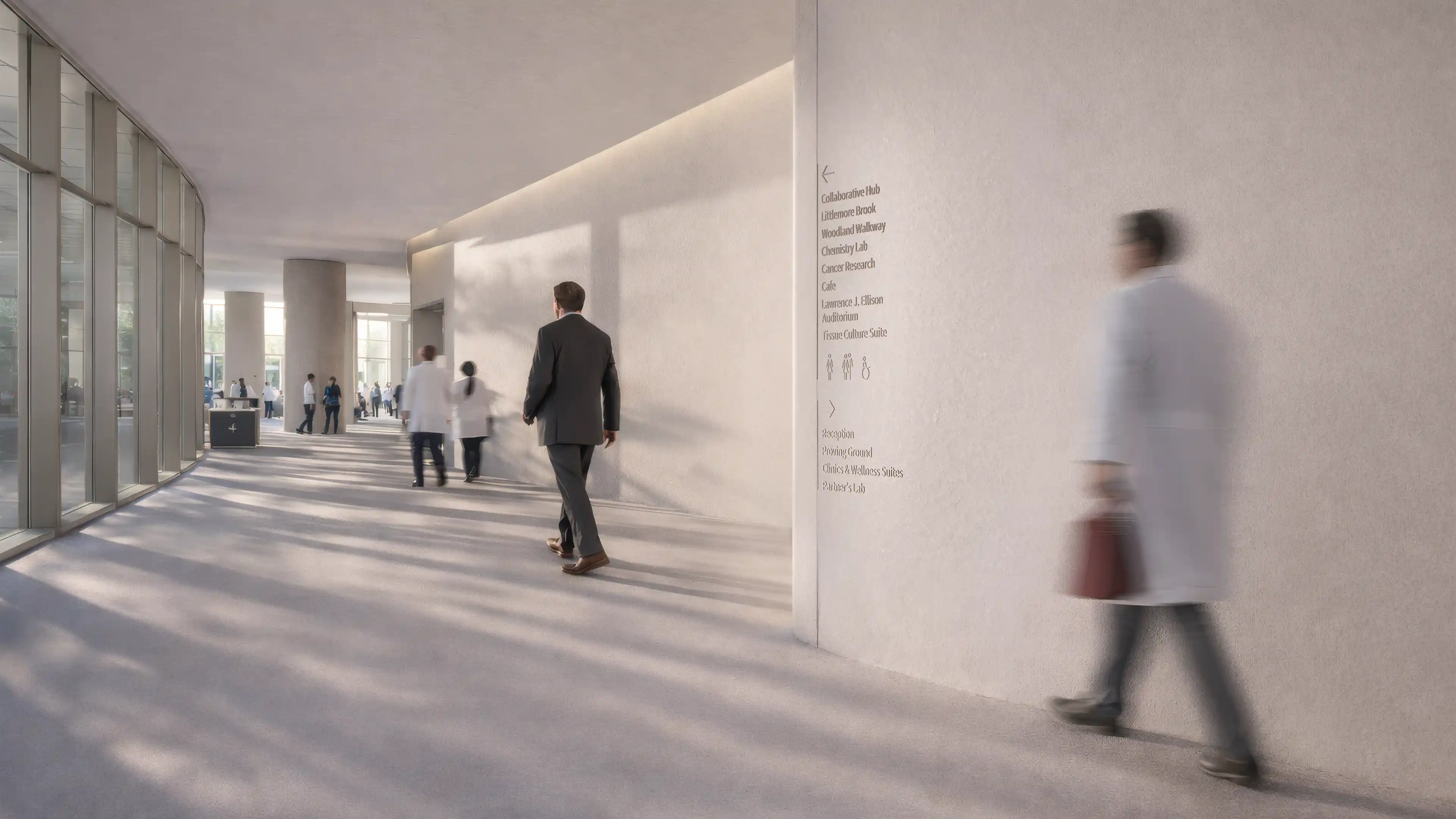



The evidence appears through behaviour. People hesitate at junctions, choose the wrong entrance, double back, gather around directories, ask staff for directions or arrive at a destination already frustrated. Each incident can look minor. Repeated across a busy hospital, airport, campus, mixed-use development or public venue, it becomes a pattern of avoidable friction.
Good wayfinding changes that pattern. It helps people recognise where to enter, understand where they are, decide what to do next, maintain confidence along the route and know when they have arrived. Those outcomes affect more than convenience. They influence safety, user experience, accessibility, operations and the long-term performance of the asset.
The business case is therefore not that better signs automatically create financial value. It is that an integrated navigation system reduces uncertainty in the moments where uncertainty creates work, stress, delay or risk. The benefits are connected, and many of them can be observed directly.
The business case begins with behaviour, not signage
Wayfinding is still often commissioned as a package of signs added after the architecture is largely fixed. That approach starts with an output rather than the problem. A sign may be necessary, but it cannot make a hidden entrance visible, simplify an unnecessary choice or reconcile destination names that differ between the building, website and staff directions.
A complete wayfinding system includes spatial organisation, circulation, sightlines, entrances, route hierarchy, landmarks, naming, zoning, signs, maps, digital information and operational communication. The balance varies by project, but users experience these elements as one journey. When the elements agree, the place feels understandable. When they conflict, the user must solve the inconsistency.
Research supports this wider view. An integrative review of 84 studies on interior wayfinding identified floor-plan configuration, landmarks, signage and maps as recurring environmental influences. National Academies research on airport access similarly treats wayfinding as a complete journey and connects it with architecture, lighting, landmarks, decision points, information continuity and accessibility.
This matters commercially because it changes what the project should evaluate. The question is not only whether the signs are attractive or compliant. It is whether the environment helps intended users complete important journeys with reasonable independence, confidence and effort.

Safety improves when the environment makes decisions clear
Safety is often discussed only in relation to emergency signage or statutory compliance. Those requirements are essential, but everyday navigation clarity also affects how people move through the environment. Uncertainty can cause people to stop in active circulation areas, reverse direction, cross movement flows or concentrate around help points and directories.
The consequences become more serious when the environment is crowded, time-sensitive or unfamiliar. A patient looking for the correct clinic, a passenger moving towards a departure gate or a visitor searching for an accessible entrance has limited capacity for trial and error. Clear hierarchy and timely information help the user recognise the correct choice before committing to the wrong route.
Good wayfinding does not guarantee that every person will make every decision correctly. It reduces avoidable ambiguity. Entrances should be recognisable. Primary routes should appear more important than secondary ones. Information should arrive before the choice, use stable terminology and confirm progress after the user has moved.
Safety performance can be examined through behaviour rather than broad claims. Repeated conflicts at junctions, stopping at the top of escalators, wrong-way movement, crowding around information points and reliance on staff at critical transitions are all signals that the navigation system may be contributing to risk.
User experience is built through confidence across the journey
A place can be visually impressive and still feel difficult to use. The experience begins before the visitor reaches the main interior. Road access, parking, public transport connections, drop-off, entrance recognition and the first point of orientation all shape the user's confidence.
Confidence is not created by one perfect sign. It develops through continuity. The destination named in an appointment message should match the terminology used at the entrance. The route should remain visible or be confirmed at the next decision. A user who makes a wrong turn should be able to recognise the error and recover without returning to the beginning.
When that sequence works, movement feels easier and the place feels better organised. Users spend less attention interpreting the environment and more attention on the purpose of their visit. In healthcare that may mean focusing on an appointment. In retail it may mean exploring. In a cultural destination it may mean engaging with content rather than managing the route.
This is why navigation quality influences perception. People may never use the term wayfinding, but they notice whether arrival was clear, whether they felt lost and whether they needed help. The functional experience becomes part of how they judge the quality of the asset and the organisation behind it.

Accessibility depends on independent understanding
Accessibility standards establish important minimum requirements, but compliance alone does not guarantee an understandable journey. A sign can meet technical criteria and still appear after the user needed it. An accessible route can exist and still be difficult to identify from the main arrival point.
Inclusive wayfinding considers how different people perceive, process and act on information. Users may have visual, auditory, cognitive or physical differences. They may not speak the primary language, may be unfamiliar with local conventions or may be navigating while tired, anxious or distracted. The system should not assume one level of mobility, literacy, vision or prior knowledge.
The response is not simply to place more information everywhere. It is to create clear route hierarchy, consistent language, sufficient contrast and legibility, recognisable landmarks, accessible maps and appropriate tactile, auditory, digital or human support. Different channels should reinforce the same structure rather than create competing versions of the place.
Independence is a useful performance standard. If a journey can only be completed because staff routinely intervene, the service may be compassionate but the environment is still carrying too little of the navigational burden. Improving that journey benefits the user who needs support most and usually makes the place easier for everyone else.

Operational performance reveals the hidden workload of confusion
Navigation problems rarely sit within one operational budget. The burden is distributed. Reception teams answer basic directional questions. Security staff manage congestion. Clinical or customer-facing teams interrupt their primary work to guide visitors. Facilities teams install temporary signs and repeatedly correct information after destinations change.
Because each intervention is small, the total can be difficult to see. Yet repeated directional queries, late arrivals, queues at help points, complaints and unofficial signs are not random events. They are operational evidence that the environment, information or service model is not supporting the journey consistently.
Good wayfinding reduces this friction by giving every channel the same logic. Destination names should match across websites, booking messages, maps, signs and staff directions. Route changes should be communicated through a hierarchy that users already understand. Content ownership should be clear so that updates do not create conflicting information.
The objective is not to remove every request for assistance. Some users will prefer or require human support, and service should remain available. The objective is to prevent avoidable confusion from becoming a recurring operational task and to reserve staff attention for situations where it adds real value.
Asset value is protected when the place continues to work
Asset value is often discussed as if it can be attributed to one intervention. Wayfinding should not be presented that way. A navigation system does not independently determine rental performance, footfall, clinical outcomes or financial valuation. Those outcomes depend on many factors.
Wayfinding contributes by protecting the conditions through which value is realised. A place must be usable before it can perform its intended role. Visitors need to find tenants and amenities. Patients need to reach services. Passengers need to move through processes. Staff need routes and information that support operations. When these journeys repeatedly fail, the asset carries friction that design has not resolved.
Long-term value also depends on adaptability. Departments move, tenants change, entrances close, transport connections evolve and digital channels are updated. A system based on a clear destination hierarchy, maintained information and consistent rules can absorb change more effectively than a collection of isolated signs.
The value case is therefore one of usability, resilience and reputation. Good wayfinding helps the asset remain understandable as conditions change. It supports confidence in the place and reduces the likelihood that short-term fixes gradually weaken the environment. Detailed cost, fee and ROI analysis belongs in a dedicated article because it requires project-specific evidence rather than universal claims.
The evidence points to a complete system
Wayfinding research does not support the idea that one visual treatment works everywhere. It points instead to the interaction between people, information and environmental structure. Floor-plan complexity affects route choice. Landmarks support orientation when they are visible, distinctive and located where they help a decision. Signs and maps work when their content, placement and timing fit the journey.
Healthcare guidance provides a useful example because the consequences of confusion are easy to observe. NHS guidance approaches wayfinding as a system that can be assessed and improved across the complete site. Environmental psychology research similarly argues for coordinated systems because ease of wayfinding affects stress and the ability to use the facility.
Airport research extends the same principle across organisational boundaries. The passenger experiences one route even when roadway, terminal, airline, security, retail and transport information are controlled by different parties. Continuity is a performance requirement because the user should not have to translate between separate systems.
The practical conclusion is straightforward. Good wayfinding cannot be judged by looking at sign families in isolation. It must be evaluated through complete journeys, representative users and the points where space, information and operations meet.

Good wayfinding can be measured without inventing ROI
Clients do not need a complex analytics platform to understand whether navigation is working. The most useful starting point is a baseline of observable behaviour and operational demand on the journeys that matter most.
Useful performance indicators may include:
Hesitation, backtracking or sudden changes of direction at important decision points.
Repeated requests for directions received by reception, security or operational staff.
Users arriving at the wrong entrance, floor, department or destination.
Congestion caused by people stopping to interpret information or recover from a wrong route.
Differences between destination names used on signs, maps, websites, messages and verbal directions.
Accessible routes that require assistance because their entrance, lift or continuation is unclear.
Temporary or unofficial signs appearing repeatedly after opening.
Complaints or feedback that identify the same confusing journey or location.
The time and coordination required to update navigation information when the asset changes.
These indicators should be interpreted by journey and user group. One recurring problem at a critical hospital transition may matter more than many minor questions in a low-pressure public area. The purpose is not to create a universal score. It is to identify where uncertainty repeats, diagnose its cause and judge whether the intervention changes behaviour.
Where reliable operational data exists, it can strengthen the review. Help-desk records, staff feedback, complaints, route testing, digital searches and movement data may reveal patterns. The evidence must still be connected to the physical situation. A count without observation can show where demand occurs but not why.
Early integration produces the strongest benefit
Many of the decisions that determine navigation performance are made before signage design begins. Entrance location, vertical circulation, sightlines, destination relationships, route hierarchy and naming all influence how much explanation the finished environment will require.
When wayfinding expertise is involved early, the team can prevent uncertainty rather than document it. A route may be simplified, an entrance made more visible, a landmark aligned with a decision point or a destination hierarchy agreed before different project teams create incompatible terminology.
Existing and advanced-stage assets can still improve. The starting point should be diagnosis: observe journeys, identify repeated failure points and determine whether the cause sits in space, information, operations or coordination. The answer may include signs, but it may also require naming changes, digital updates, environmental cues, staff guidance or a revised route.
Procurement should reflect this scope. If the brief asks only for sign types and locations, the consultant has limited authority to resolve issues elsewhere. A performance-led brief should define users, journeys, operational conditions and desired outcomes, then allow the appropriate combination of interventions to be developed and tested.
The value sits in the chain, not one output
Good wayfinding improves a place because it connects decisions that are often managed separately. Architecture establishes the spatial logic. Naming and information architecture organise destinations. Landmarks and environmental cues support orientation. Signs, maps and digital tools communicate choices. Staff and governance keep the system consistent as the asset changes.
If one link breaks, the user carries the burden. A clear sign cannot fully recover a hidden entrance. A strong map cannot resolve conflicting names. A useful app cannot compensate for an accessible route that is difficult to recognise on arrival.
LIMAH approaches Wayfinding & Navigation as part of Built Environment Experience Design because the user does not experience separate design packages. They experience one place and one journey. Our role is to connect the human, spatial, informational and operational logic so that the environment becomes easier to understand and manage.
The strongest business case is not more signage. It is less avoidable uncertainty. When people can make safer decisions, move with greater confidence, navigate more independently and rely less on operational correction, the place performs better. That is how wayfinding supports the long-term value of the asset.